 By admin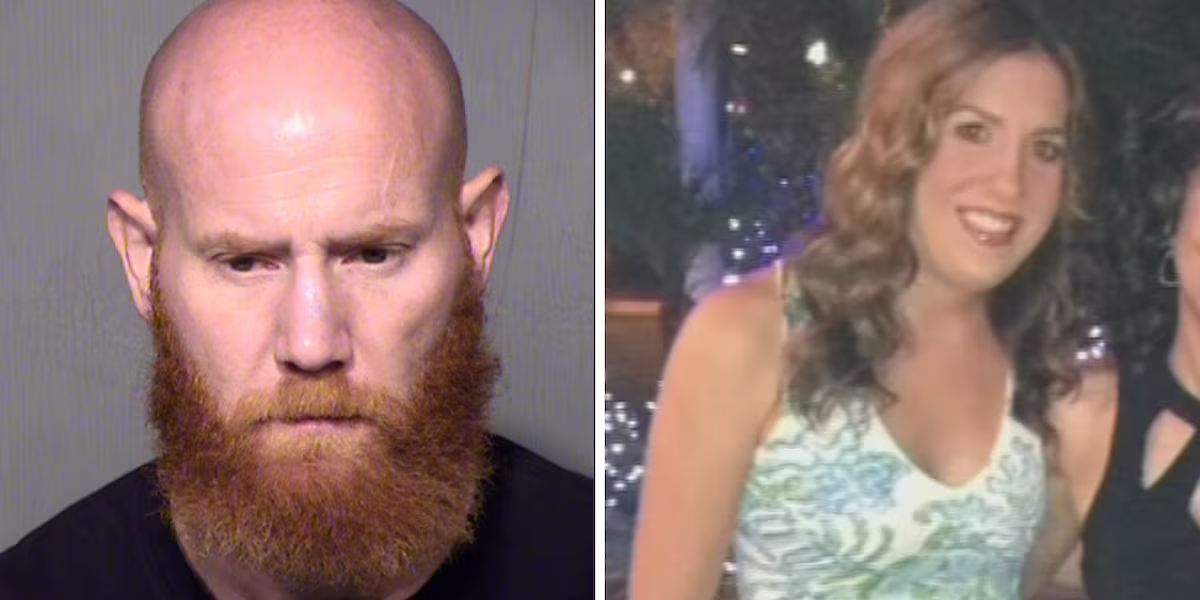
PHOENIX (AZFamily) — A jury will soon decide whether Ian Mitcham should be sentenced to death for the 2015 murder and sexual assault of Allison Feldman inside her Scottsdale home.
Read more Trump calls off AI executive order over concern it could weaken US tech edge
Closing arguments were completed Thursday afternoon in the sentencing phase of Mitcham’s trial. The jury is now deliberating.
On April 9, Mitcham was convicted of murdering and sexually assaulting Feldman, whose death remained unsolved for years before investigators said DNA evidence connected him to the crime.
Police and Feldman’s family have said there is no known connection between Feldman and Mitcham and no known motive. Prosecutors have argued the attack was a crime of opportunity, tied to Mitcham’s life circumstances at the time.
During the trial, prosecutors described Mitcham as down on his luck, angry, drinking too much and feeling as though he had nothing left to lose. They said DNA evidence tied him to the scene.
Mitcham and his defense attorney maintain he is innocent and argue that investigators failed to fully pursue another possible suspect.
Joshua Kolsrud, a criminal defense attorney not affiliated with the case, said remorse, or lack thereof, could play a role in sentencing.
“If I were Ian Mitcham’s attorney, I would certainly have my client show remorse to the victim’s family, to the court, the prosecutor,” Kolsrud said. “And you can show remorse without admitting guilt in the case. Because, again, you want to preserve the actual innocence argument later on when this case is appealed.”
Read more High Desert State Prison inmate stabbed to death, deemed homicide
DNA evidence and legal precedent
Investigators found partial DNA at the scene in 2015, but there was no direct match to anyone in the system. The case went cold until 2018, when Scottsdale police ran a familial DNA test that identified an Arizona prison inmate as a close relative to the murder suspect.
The trail led to his brother Ian Mitcham, whose blood was already in the Scottsdale police vault from a DUI investigation.
A judge ruled that DUI DNA should not be used because it was not destroyed three months after his arrest, violating his rights. The prosecution appealed, and the case went to the Arizona Supreme Court.
Justices decided that keeping the evidence did violate Mitcham’s Fourth Amendment rights. But the justices said police would have discovered the DNA evidence through other lawful means untainted by the illegal search after Mitcham was arrested for different crimes.
Kolsrud said that precedent will be used in future cases.
“This is an important case for precedential reasons, because it’s the first case in Arizona where familial DNA led to the apprehension and charges of a defendant, a cold case,” Kolsrud said. “And now, you know, both defense attorneys and prosecutors alike are going to have a roadmap as to what the admissible evidence is in similar situations.”
See a spelling or grammatical error in our story? Please click here to report it.
Do you have a photo or video of a breaking news story? Send it to us here with a brief description.
Read more Police ask public for help after bicyclist dies from crash near Goodyear elementary school