 By admin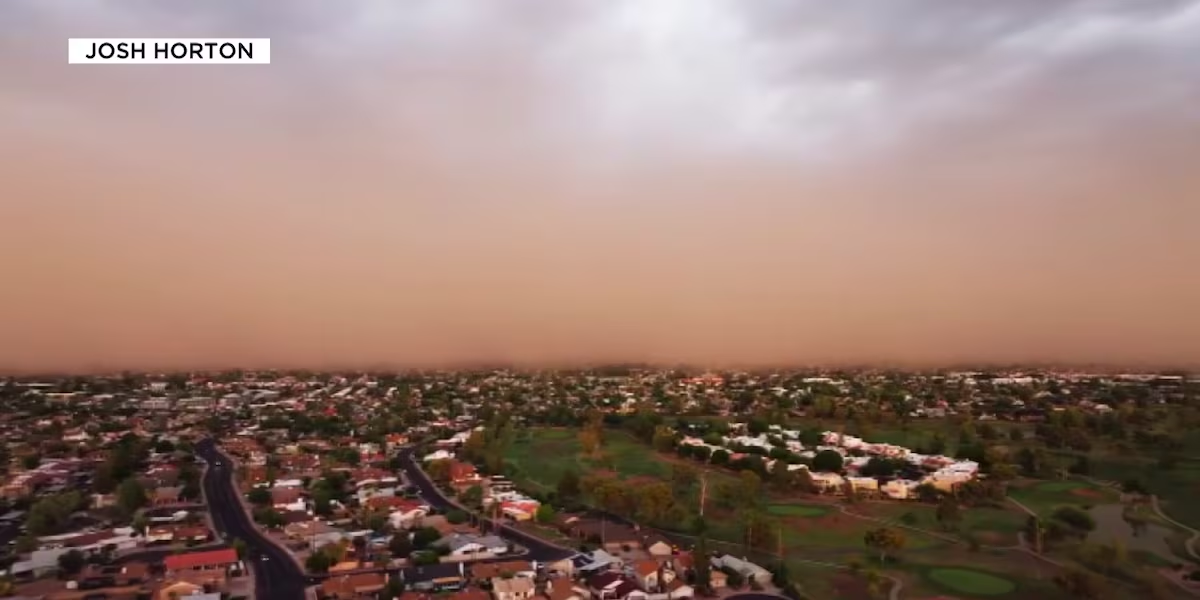
PHOENIX (AZFamily) — Researchers at Arizona State University are using this week’s monsoon storms to put a new dust storm rating scale into practice for the first time, assigning category rankings as the storms move through the Valley.
Read more Does Arizona have enough workers for TSMC’s Phoenix expansion?
The scale ranks qualifying storms from Category 1 to 5 using dust concentrations, storm duration, wind gusts and how much of the Valley is affected.
“Everybody’s always had a big love for dust storms,” said Randy Cerveny, a professor in ASU’s School of Geographical Sciences and Urban Planning. “And the way that we’ve had in the past was simply to show imagery. We didn’t have the way to put it in numbers.”
Four storms ranked in the past week
Four dust storms have already been ranked since the scale went into active use. Two storms last week were rated Category 2. Sunday’s storm was ranked Category 3, and Monday’s storm came in as a high-end Category 1.
Ryan Heintzman, an assistant teaching professor at the school, said the team is now analyzing storms within 24 hours of occurrence.
“This is definitely the first time that we’ve made it more accessible and that we’re actually looking at these events within 24 hours after they happen,” Heintzman said.
Health implications tied to category rankings
The scale also carries public health implications. Heintzman said a person outside during a Category 1 storm for one hour could inhale roughly 200,000 to 250,000 particles of dust. Exposure during a Category 5 storm for the same duration could mean breathing in approximately 1.3 million particles.
Cerveny said a review of the past 15 years found only three storms that reached Category 5 strength.
Read more Lettuce sold at some Taco Bell locations linked to ‘explosive’ diarrhea parasite
“Those are all memorable ones; ones that have made an impact here on the community,” he said.
Rain timing affects storm intensity
Cerveny, who helped launch the project during the COVID-19 pandemic, said the scale is already providing new insight into how rainfall affects dust levels.
“As these storms come through the Valley, if there is significant time between when they hit and the rain that is behind them, we’re going to have bigger dust storms,” Cerveny said. “If the rain happens just moments after the dust ball comes through, then the effects of the dust storm are going to be more limited because the rain will knock the dust out of the sky.”
Researchers said they hope the rankings will help communities better understand one of Arizona’s most dangerous weather hazards over time.
See a spelling or grammatical error in our story? Please click here to report it.
Do you have a photo or video of a breaking news story? Send it to us here with a brief description.
Read more Man in custody after girlfriend shot dead at Peoria mobile home park