 By admin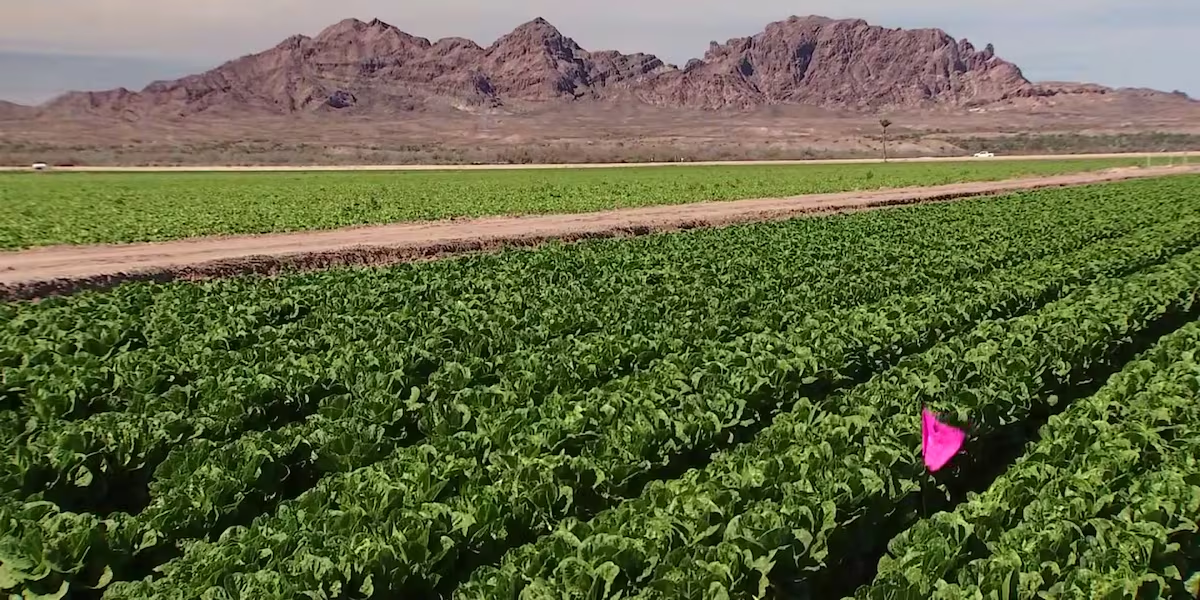
YUMA, AZ (AZFamily) — A single-celled parasite that has caused outbreaks in the United States for decades is again making people sick across the country.
Read more Another University of Arizona fraternity sanctioned over hazing
A food safety expert says Yuma County could still face exposure, even without any reported local cases.
Cyclospora, a protozoan parasite shed by humans, can get into water supplies or onto food and trigger cyclosporiasis, said Kali Kniel, a professor of animal and food sciences at the University of Delaware who has worked with the produce industry in Yuma.
“It’s a single-celled organism, and that’s why we call it a protozoan parasite, and it’s shed by humans … which is how it gets either into a water supply or onto contaminated food,” Kniel said.
Cases have been reported in about 17 states. After exposure, it can take two to 14 days for symptoms to begin, including watery diarrhea, severe stomach cramps, bloating, nausea and fatigue.
Kniel said Yuma County has not reported any cases, but that does not mean the region is immune.
“It is possible that water that is being used in Yuma to irrigate crops, that is in the canals there, could become contaminated,” she said, adding that water filtration can be used and that basic produce safety rules remain important.
Kniel said the parasite may be able to withstand Yuma’s hot, dry conditions, though extreme heat can render it inactive.
Read more FACT FINDERS: No Labels Party on Arizona primary ballot amid name change dispute
When produce becomes contaminated with parasites or bacteria, growers often recall affected products from warehouses through the supply chain and off grocery store shelves. Kniel said growers may need additional steps to inactivate the organism because its oocysts can be resistant to disinfectants and sanitizers.
“And because again those oocysts are so resistant to disinfectants and sanitizers, then those growers would need to find a way to inactivate them,” she said.
Kniel added it is unlikely an entire field in Yuma would be contaminated.
The last time Yuma County was linked to a national outbreak was in 2018, when E. coli was found in romaine lettuce.
Kniel said a key factor with Cyclospora is that it is shed by humans, not animals, shifting the focus away from wildlife intrusion and toward preventing human contamination in fields.
“We really are focused on humans,” she said.
Kniel said it is important for growers to quickly identify if a field worker becomes infected to prevent potential spread to produce.
See a spelling or grammatical error in our story? Please click here to report it.
Do you have a photo or video of a breaking news story? Send it to us here with a brief description.
Read more Suspect arrested after fight leads to deadly shooting near Flagstaff apartment