 By admin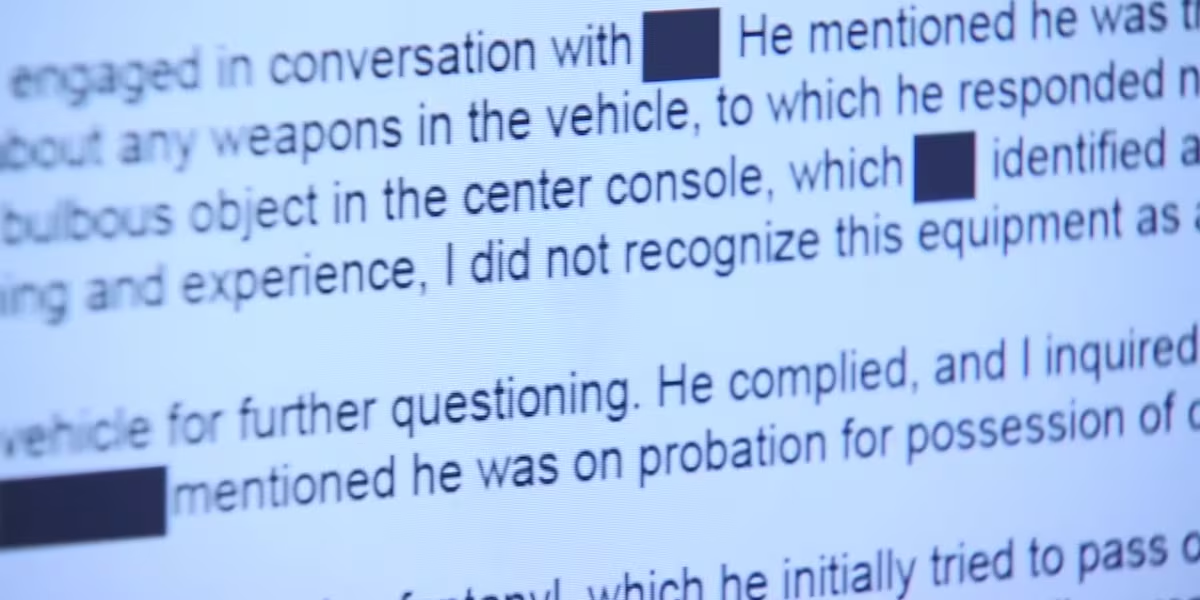
PHOENIX (AZFamily) — Law enforcement agencies across the country are turning to AI to catch criminals and handle mundane aspects of the job, but critics argue these AI tools come with real risks.
Read more Beloved family-owned Mexican restaurant in Tucson vandalized
One tool leverages an officer’s body camera video to help write police reports. Scottsdale-based Axon offers a product called Draft One, which transcribes audio from body camera footage and produces a first draft of a police report.
Scottsdale police started using Draft One in a pilot program last year, and they say it saves at least 30 minutes of officer time for each report.
“You don’t have to wait until you go back to the station to dock your camera, to upload your camera, so officers can, in their cars, go into Evidence.com, they can pull up their reports, and they can use Draft One and instantly have a draft,” said Scottsdale Police Sgt. Paul Wright.
Wright said freeing up staff time is especially useful when departments are facing budget pressures and struggling to recruit and retain officers.
“It helps because throughout the officer’s shift, they’re more available to take calls for service, to be available to the public, to be community policing,” Wright said.
Critics warn that these AI-generated reports could contain consequential mistakes.
“To me, it seems like sloppy at best, or dangerous at worst,” said Dave Maass, investigations director at the Electronic Frontier Foundation.
On the latest episode of Generation AI, Maass said using AI in police reports could introduce the same errors seen in schools when students use it for plagiarism or in courts where lawyers introduce citations that don’t exist.
“This is just going to start ending up in police work, ultimately resulting in bad policing, maybe even people getting off the hook because of mistakes that were made by the AI system,” Maass said. “But it could also result in bias or mistakes that put innocent people in the crosshairs of an investigation.”
Real-world errors
Maass cited a January case in Heber City, Utah, where the police report said an officer turned into a frog midway through responding to an incident.
“That’s what the AI thought happened. Somebody turned into a frog,” Maass said.
In reality, the AI transcription software could not distinguish between what was happening on the scene and what was happening on the television. The Disney movie The Princess and the Frog was playing in the background, and the software merged the audio narratives.
Read more Not rats, not raccoons: Bobcats found living in Scottsdale attic
“If you think of every incident where there’s multiple people talking, maybe in different languages, maybe using different kinds of idioms and slang, and the AI just kind of throwing that together and making up something, and an officer not checking it closely enough,” Maass said. “I mean, those are the kinds of problems that we expect to happen and we’re already starting to see them happen.”
Department safeguards
The Scottsdale Police Department did not immediately respond to inquiries about its use of Draft One. Still, in a report by Arizona’s Family last year, a spokesperson said any report written with the AI system will include a disclaimer in the report itself. The department said it requires human verification before the report is submitted.
“It’s very important that we get those details right in the reports. Not just initially, but again, for courts, for records, for prosecution,” Sgt. Wright said. “This isn’t ChatGPT. It’s not bringing in content that wasn’t there in the first place.”
Maass questioned whether the department really is saving 30 minutes per report.
“I think if you work in journalism or you work in academia or you edit publications, most editors will tell you that it often takes as long to fact-check and edit a document than it takes to write it in the first place,” Maass said. “So the idea that this is somehow cutting time, what it’s actually cutting time is the time from reviewing and getting the facts right.”
Once errors are introduced into a document, it could infect the whole system, Maass argued, especially when AIs look at content generated by other AIs.
“So I don’t think this is a win for public safety. I don’t think it’s a win for the officers. I don’t think it’s a win for the public,” Maass said.
Maass said he could see beneficial uses for AI in law enforcement, but in much more limited capacities, such as flagging typos or automatically filling in time stamps.
“I think when you have AI write your first draft, it is replacing your first draft,” Maass said. “When you have AI coming in and looking for typos, that still is your work at the core of it. You’ve used something to help you do a better job, not use somebody to replace the job you should be doing.”
See a spelling or grammatical error in our story? Please click here to report it.
Do you have a photo or video of a breaking news story? Send it to us here with a brief description.
Read more Tucson teen girl in critical condition after near-drowning incident