 By admin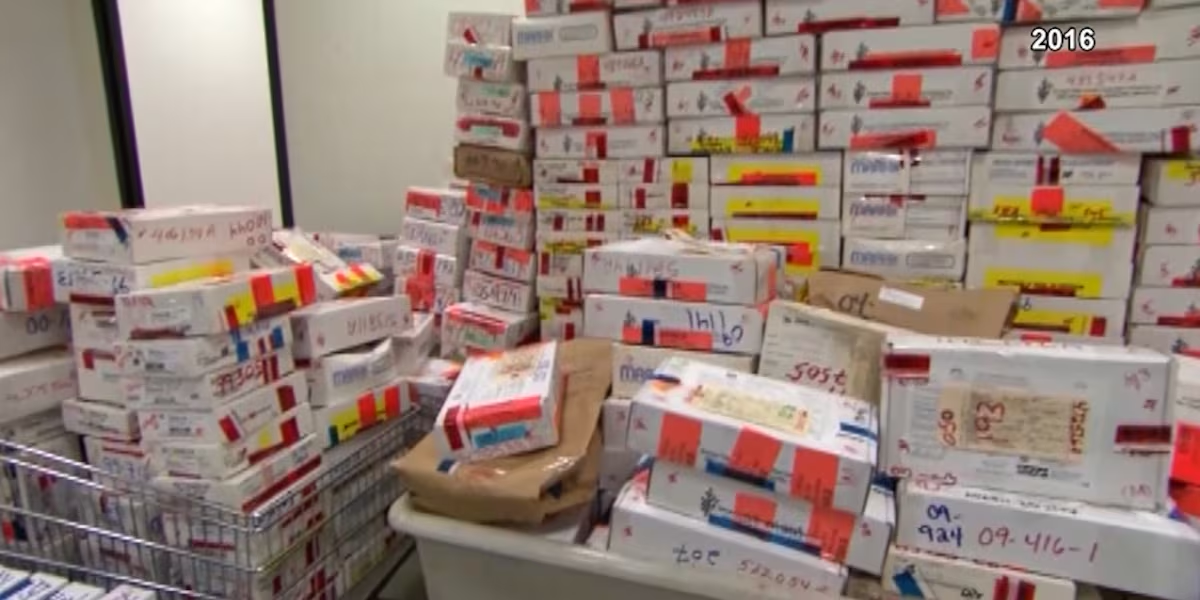
TUCSON, Ariz. (13 News) – Decades after their assaults, sexual assault survivors in Tucson are seeing justice following the DNA testing of thousands of backlogged rape kits.
Read more Prosecutors push for a trial for the man accused of killing Charlie Kirk
A $1 million grant awarded in 2016 allowed the Tucson Police Department to begin testing a backlog of roughly 2,000 sexual assault kits.
About 1,000 produced DNA results. Of those, approximately half generated matches to known offenders, according to Tucson Police Detective Dallas Wilson, who works on sexual assault cold cases.
More than 100 serial offenders identified
Since testing began, Tucson police have identified more than 100 serial offenders. Fourteen have been convicted, with additional cases still moving through the courts.
Wilson said DNA testing was not always routine prior to Arizona’s laws changing in 2017. If detectives believed a suspect was a known or potentially consensual partner, the kit often went untested.
“They thought it would just show that DNA was there,” Wilson said. “It wouldn’t show that a sexual assault actually occurred, because it was going to be his DNA in there consensually.”
Some sexual assault kits date back to 1980s
Wilson said the department’s backlog of untested kits stretched back decades.
“We have sexual assault kits going all the way back to the 80s,” Wilson said. “Most of these survivors feel like their cases have been forgotten about or neglected and not even cared about.”
Some DNA profiles appeared on multiple kits, revealing serial offenders who had gone undetected for years. Wilson said one question often determines whether a survivor chooses to move forward with their case: whether there are other victims.
“If there are other victims, those victims band together and want the case reopened,” Wilson said.
Survivors are notified face-to-face
For about 700 survivors, DNA evidence has reopened cases once thought unsolvable. Wilson said he tracks down survivors — sometimes in other states — to deliver the news in person.
“It’s important to me to actually go in person and notify them face to face and let them know that I do care and I do want to reopen the case if that’s what they’re willing to do,” Wilson said.
Read more Man accused of shooting girlfriend during argument in Avondale
Wilson said survivor reactions vary, but are always emotional.
“This brings up old wounds,” Wilson said. “They are ultimately appreciative regardless of whether they want to go forward or not.”
He said some survivors choose not to pursue their cases further.
“There have been victims that some of them don’t even want to know who the perpetrator was,” Wilson said. “They want to move forward with their lives.”
Survivor waited nearly 30 years for answers
A survivor identified only as J.L. said she waited nearly three decades before receiving any update on her case.
“No. Not a word one. No,” J.L. said when asked whether she received any follow-up from police.
She said the lack of contact left her feeling dismissed.
“You feel like trash,” J.L. said.
J.L.’s rapist was convicted 29 years after her assault. She said knowing the offender can no longer victimize others brought her a sense of closure.
“These people can no longer hurt other people,” J.L. said. “I think the majority of them are habitual offenders. So, you can’t do this anymore. That’s closure to me.”
Wilson described the grant and updated technology as a turning point for cold case investigations.
“Now with this grant and the new technology, we’re able to go back and not only reopen the investigation but notify the victim of who the assailant was and get actual DNA testing, and in some cases go forward through trial and get justice,” Wilson said.
Are you streaming 13 News?
Watch a free live stream of Tucson Now and 13 News at TucsonNow.Live.
Be sure to download the free Tucson Now app, which you can find on Apple and Google.
If you are using a desktop computer, you can use your mobile device to scan the QR code below.
Read more Operation Chill Out, county cooling centers to expand resources during early heat wave
You can submit your breaking news or weather images here.