 By admin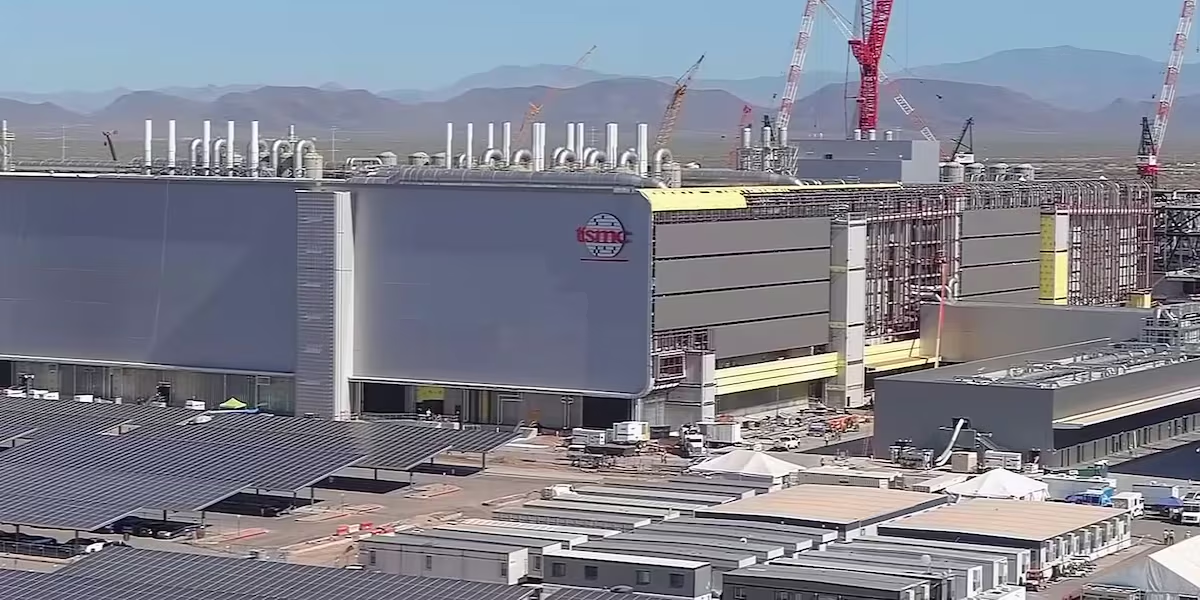
PHOENIX (AZFamily) — A report from the United States Joint Economic Committee shows the country is running a trade deficit of nearly $56 billion in April.
Read more Tohono O’odham Nation files lawsuit against DHS
Economists say this means the U.S. is buying more from other countries than it is selling out. The deficit highlights U.S. reliance on imports from Taiwan, especially as Arizona builds up its chip industry.
Even with investments like TSMC expanding in the Valley, an Arizona State University supply chain economist says it will take years before Arizona production is big enough to make a significant impact.
Why Taiwan is part of Arizona’s story
The gap with Taiwan is a reminder of how much the U.S. and Arizona companies still rely on overseas semiconductors and electronics, even as major chip investments accelerate in the Valley.
Companies like TSMC and Amkor are expanding operations in Arizona, but experts caution it will take years before local production is large enough to significantly reduce dependence on imported chips.
Arizona chip production will take time to scale
Hitendra Chaturvedi, an ASU supply chain economist, said building and ramping up fabrication facilities is a long process, and even at full capacity, Arizona would represent a fraction of TSMC’s overall production.
“We need to understand that manufacturing of a fab facility takes time,” Chaturvedi said.
He said if current plans stay on track, TSMC’s Arizona operations could eventually reach about 100,000 wafers per month.
“If everything goes according to plan, Arizona’s fab manufacturing facilities, by TSMC, will be generating about 100,000 wafers per month,” he said. “That is 1.2 million per year.”
Read more Aluminum Dynamics pulls out of Benson following pushback
Chaturvedi added that compared with TSMC’s worldwide output, that would still be relatively small.
“TSMC produces about 17 million wafers per year. So, at 1.2 million, at full production capacity, in 2030, Arizona will be only at 7% of the global production of TSMC,” he said.
What happens next
TSMC has said it expects three fabs operating in Arizona by 2030, though there is still no announced timeline for the remaining three it has discussed long term.
Economists say the uncertainty matters — especially with ongoing questions around tariffs and global conflicts that can rattle markets and supply chains.
They also emphasize that more chipmaking in Arizona doesn’t automatically mean lower prices for consumers, because costs can still be affected by materials, equipment, labor, and broader global market shocks.
See a spelling or grammatical error in our story? Please click here to report it.
Do you have a photo or video of a breaking news story? Send it to us here with a brief description.
Read more Study: Lake Mead water levels projected to drop 30 feet by 2028