 By admin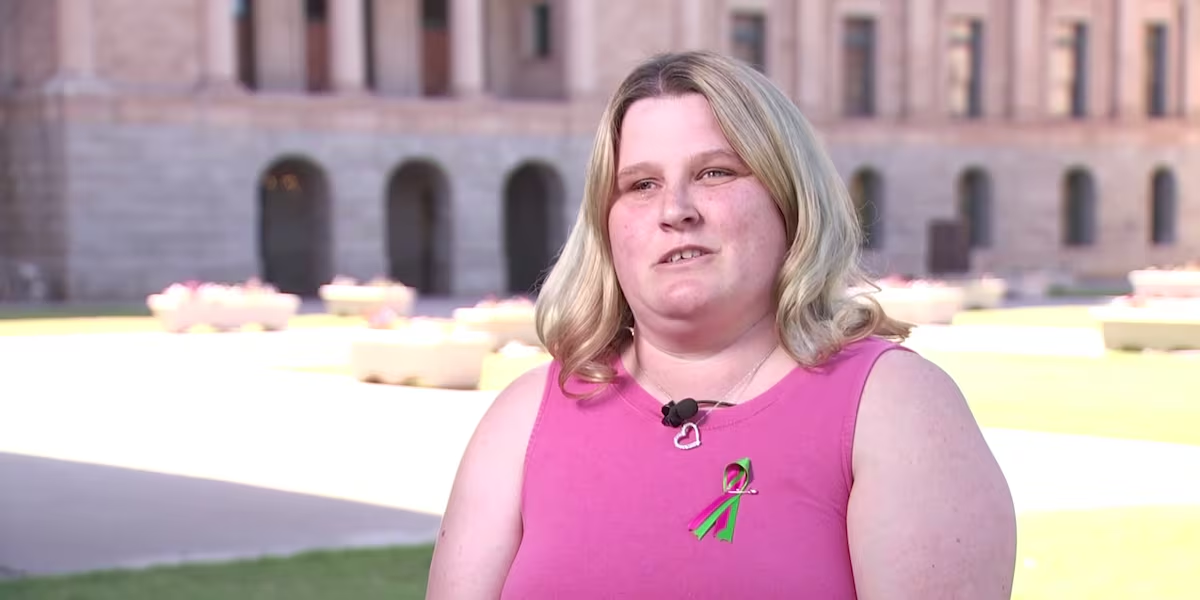
PHOENIX (AZFamily) — A bill moving forward at the Arizona State Capitol would require judges to prioritize domestic violence in custody cases.
The legislation comes after a mother’s children were killed while their father had court-ordered custody.
Hope Hooton’s children, Alec and Lydia, were gunned down by their father in 2024. He then took his own life.
“This bill is really to make sure that what happened to my family doesn’t happen to any other Arizona family,” Hooton said.
Hooton now wears a memorial tattoo on her right arm.
“Alec loved Pikachu and Pokemon. Pikachu was his favorite. And Lydia, my daughter, loved unicorns,” Hooton said. “The stars represent the phrase they use to tell me, which was, ‘I love you to the last planet and back.’”
Bill would create mandatory presumption against abusive parents
, nicknamed the “Alec and Lydia Act,” would overhaul how judges handle custody when there is domestic violence. The bill would force judges to put a child’s safety first when making custody decisions over a parent’s rights.
“We are hopeful the bill will pass and protect Arizona children,” Hooton said.
, if a court determines a parent has committed domestic violence, judges would have to assume that giving custody or parenting time to that parent is not in the child’s best interests. The abusive parent would then have to prove otherwise.
To get any custody or unsupervised visits, that parent would need to meet a high legal standard with clear evidence. Even for supervised visits, the parent would need to prove the child would be safe.
Judges currently have discretion in custody cases. The bill would require courts to assign the highest priority to the personal safety and physical, mental and emotional well-being of both the child and the victim of domestic violence.
Bill would expand definition of domestic violence
The legislation would define domestic violence to include coercive control, described as a pattern of violent, threatening, coercive or emotionally abusive conduct.
The bill lists 15 specific behaviors that could constitute coercive control, including threatening to kill or injure a person, monitoring financial activity, stalking, harassment and using surveillance or tracking technology.
Read more WATCH: Glendale police track down fleeing suspect who stole elderly woman’s purse
The bill would allow courts to consider evidence from law enforcement agencies, the Department of Child Safety, medical records, shelter records and witness testimony. A domestic violence claim would be established by a preponderance of the evidence, and corroboration from exhibits or witness testimony of another person would not be required.
The bill would prohibit courts from requiring victims to prove the domestic violence was severe or frequent enough to justify restricting custody or parenting time.
Courts could impose protective measures
For a parent who has committed domestic violence, the bill would allow courts to adopt precautions including requiring child exchanges in protected locations, limiting parenting time, designating supervised visits, requiring the abusive parent to pay supervision costs, suspending access to the child, requiring the parent to attend domestic violence treatment programs and keeping the child’s address confidential.
The bill would prohibit courts from ordering a victim of domestic violence to join the parent who committed domestic violence in any treatment program, counseling program or forensic assessment.
In Hooton’s case, the children’s father had a history of domestic violence and had joint unsupervised custody.
“When I hear these cases happening over and over again, I have to step up and do something because I feel like it’s my responsibility now to keep their legacy alive by doing this,” Hooton said.
Hooton helped craft the legislation and is now at the State Capitol fighting for its passage.
“I wanted to make sure that this doesn’t happen to any other family and that my children’s legacy will stay alive,” Hooten said.
For resources for those experiencing domestic violence, click or tap here.
See a spelling or grammatical error in our story? Please click here to report it.
Do you have a photo or video of a breaking news story? Send it to us here with a brief description.
Read more Canada seeks to ban social media accounts for children under 16, joining growing global effort