 By admin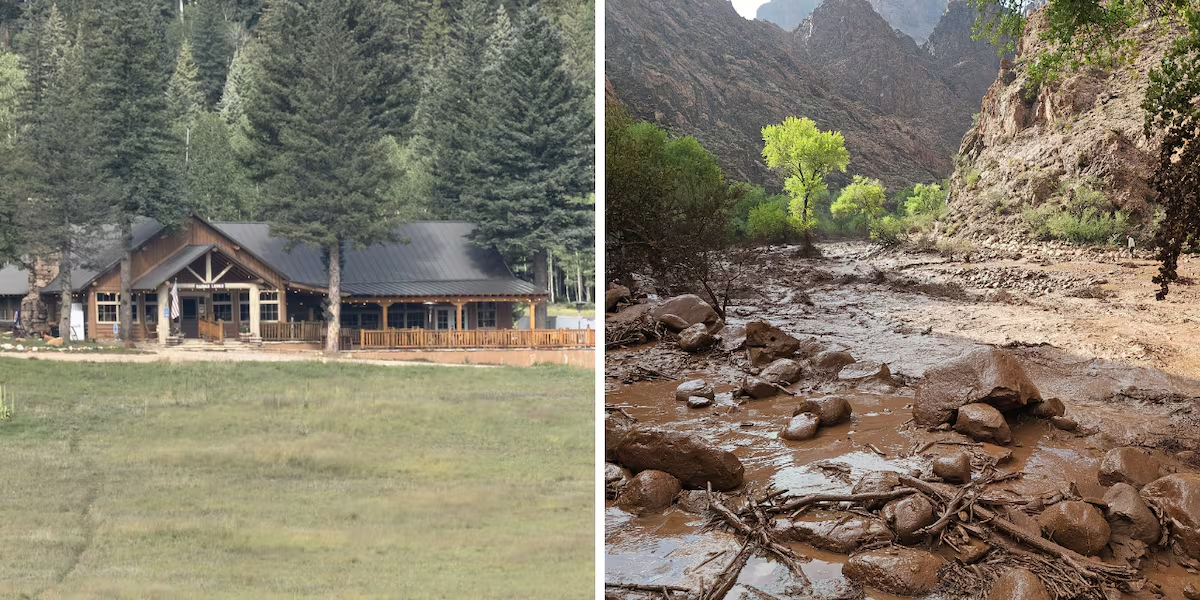
GRAND CANYON (AZFamily) — Local businesses near the Grand Canyon are struggling to pick up the pieces after devastating flash floods tore through the region late last month, wiping out vital tourism, cutting off water supplies, and leaving owners frustrated over the speed of the government’s response.
Read more Man accused of fleeing DUI stop with officers in car, crashes into Mesa apartments
For many in the community, the disaster is a second consecutive blow.
Larry Innes, owner of the Kaibab Lodge, says his business was just beginning to recover from last year’s Dragon Bravo Fire, which burned a mere four miles from his property and sliced his revenue in half. The Aug. 29 deadly flash floods, however, have proved even more catastrophic.
“It pretty much wiped out my whole client base, which is the hiker,” Innes told Arizona’s Family. “I mean, we don’t know how long it’s going to be. We were just really starting to recover from the fire last year.”
The lack of incoming tourists has forced Innes to make agonizing decisions, including laying off staff and liquidating long-held assets—including his beloved North Rim rim-to-rim shuttle service.
“I’ve got great employees, and a lot of them are very understanding, but it’s two years in a row I’ve had to lay a lot of people off,” Innes said. “What the government gives you is debt. And I’ve worked my whole life—I don’t want to give my kids a bunch of debt. So, we’re going to just do what I got to do to try to get us into next year.”
A community without water
The devastation extends far beyond lost revenue. Severe damage to local infrastructure has left portions of the canyon area without running water, complicating basic daily survival.
Kaibab Lodge has managed to keep operating by hauling and tanking in its own water supply, but many nearby residents are not as fortunate. In a show of community resilience, visitors and neighbors from the South Rim have been traveling to the Kaibab Lodge and the nearby Jacob Lake Inn just to access clean, running water.
“My heart breaks for neighbors who still have no running water,” Innes said.
Frustration mounts over state response
As the dry taps and empty registers persist, Innes and other local business owners are expressing deep frustration with what they view as a slow response from state leadership.
Innes questioned why a federal disaster has not been declared to unlock emergency relief. He also highlighted ongoing issues with State Route 67 — the highway leading to the park’s North Rim. The state routinely closes the road from Dec. 1 through May 15, choking off potential winter business.
According to Innes, he previously confronted Arizona Gov. Katie Hobbs directly about the seasonal closure.
“I’ve asked face-to-face with Governor Hobbs. She told me that she would come up and cut the lock off,” Innes claimed. “I’ve never heard anything. She’s never shown up.”
Read more No body found after search of Tempe Town Lake, police say
The governor’s defense
In response to the criticism, Gov. Hobbs’s office defended her administration’s handling of the crisis, stating she has been closely monitoring recovery efforts since “day one.”
In a statement, her office explained that Hobbs has avoided visiting the active disaster zone directly to prevent disrupting ongoing recovery work.
“Often a gubernatorial visit can strain emergency management resources and jeopardize recovery efforts in order to visit affected areas,” the statement read. “The governor wants first responders and emergency managers to finish immediate disaster response efforts before any visit is made.”
Hobbs’s office emphasized that because the disaster occurred on federal land, the response is legally spearheaded by federal agencies. However, the administration noted that the state has fulfilled every request for help.
According to the state, the Arizona Department of Public Safety (AZDPS) Air Rescue crews have played a major role, flying 13 rescue missions over late August to transport 61 stranded hikers to safety from areas including Phantom Ranch, the Bunkhouse, and Cottonwood Campground. State crews also deployed specialized canine and search-and-rescue teams to assist federal partners.
The Arizona Department of Emergency and Military Affairs (DEMA) remains in contact with county officials to assess the economic damage and determine what state-level resources can be deployed once formal requests are submitted.
For business owners like Innes, those resources cannot arrive fast enough. While he maintains that the Grand Canyon community is deeply resilient, he admits the road ahead is daunting.
“This has been some of the most challenging years,” Innes said, hoping that state leaders will pivot toward concrete solutions to help local businesses bounce back.
See a spelling or grammatical error in our story? Please click here to report it.
Do you have a photo or video of a breaking news story? Send it to us here with a brief description.