 By admin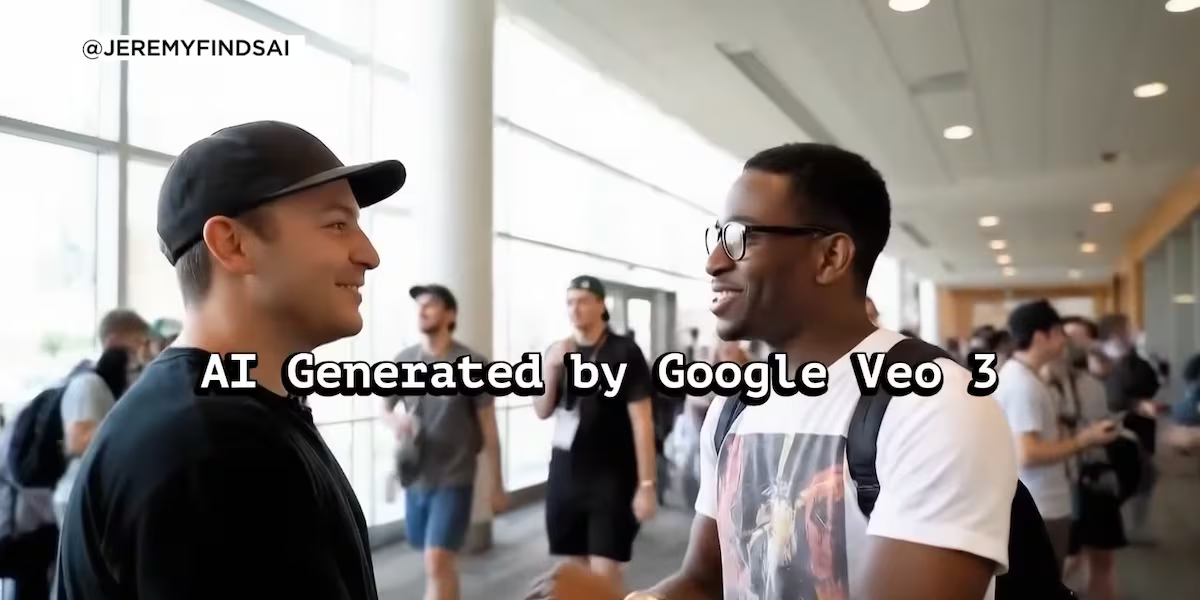
PHOENIX (AZFamily) — In the run-up to Arizona’s primary election July 21, candidates and political committees have used increasingly realistic AI-generated content to influence voters.
Read more Results of Nolan Wells’ death investigation to be turned over to grand jury, Crump says
The visuals, which are not always labeled as AI-generated, have gotten so convincing that one AI literacy creator says voters should focus on context clues and media literacy habits rather than trying to detect AI visuals alone.
Jeremy Carrasco, who has built a following online for exposing AI-generated content, appeared on Generation AI this week to discuss how AI detection has changed and what voters can do ahead of the election.
View this post on Instagram
AI tells have gotten harder to spot
Carrasco said many of the visual red flags he outlined in a 2025 video — such as distorted hands, uncanny eye movements, and unnatural mouth movements — have been largely corrected by newer AI models.
He demonstrated how far AI video has come by comparing an earlier model, Google’s Veo 3, to a newer model, ByteDance’s Seedance 2.0. He said the newer models produce more natural micro-expressions, more realistic camera movement, and more convincing overall footage.
“A lot of the tells, such as uncanny eyes or mouth movements, have been greatly improved to where you need to be really scientific about it,” Carrasco said.
He said viewers who struggled to spot AI-generated content in 2025 are unlikely to find it easier in 2026, and recommended shifting focus away from visual analysis.
Instead, he recommends viewers take a critical look at the account or website sharing the content in question. Is it a trusted source? Is the account established or brand new? Has it posted other AI-generated video?
Audio can be a key tell
Carrasco pointed to audio as an underexamined indicator of AI-generated video. He said AI models frequently fail to match audio perspective to visual distance. For example, even when subjects appear far from the camera, AI models will produce audio that sounds like a mic was placed nearby.
“In both [the Veo 3 and Seedance 2.0 versions], it acts more like a soap opera. They sound very close, even though you can see here, based on the lens angle, that they’re actually quite far away,” Carrasco said.
He also noted that newer AI models have adopted shaky, documentary-style camera movement as a realism technique, but it’s become so ubiquitous, he said, that he now recognizes it as a pattern in AI-generated video.
AI-generated text is another tell. Models have improved, but they still garble words, especially when the text is small.
Carrasco analyzed two images posted by state Rep. Walt Blackman, a Snowflake Republican seeking reelection in the July 21 primary. The images appear to show Blackman meeting with constituents and Border Patrol agents.
In Arizona, the border doesn’t start miles away —
It starts at our front door.
I met with agents on the ground to hear directly what they’re facing and what Arizona communities need.Secure borders mean safer neighborhoods, stronger law enforcement, and a safer future for our… pic.twitter.com/Qa8GeDRWYB
Read more Santa Rita Park grand reopening pushed back due to equipment shipping delay
— Chairman Walt Blackman LD7 Representative (@BlackmanForAZ) March 14, 2026
“The patches on the agent-looking personas were quite illegible,” Carrasco said. “AI text is still pretty messed up in both AI videos and photos, especially when it’s small.”
Blackman is not alone. Candidates from both parties have turned to AI-generated content this cycle, from a Democratic congressional candidate’s fully AI-generated ad to a state senator’s video vanquishing his opponent with a proton pack.
I’m out here listening, showing up, and hearing what matters most—because real solutions come from real conversations. No hiding. No scripted lines. No political games.
It’s time to stop talking at people and start working with them.
Enough is enough. Let’s Get Real.… pic.twitter.com/QzbnhojfKO
— McCartney for Congress (@RickMcCartneyAZ) May 5, 2026
I’m State Senator John Kavanagh, and I ain’t afraid of no bathroom spirits, like the one my primary opponent Robert Wallace sees. pic.twitter.com/RqbeAig4Jh
— Senator John Kavanagh (@JohnKavanagh_AZ) May 20, 2026
Carrasco said the responsibility for disclosure falls on the creators of AI content, not on viewers to detect it. He recommended approaching unfamiliar content with a baseline of skepticism and checking source credibility before attempting any visual analysis.
What Arizona law says about AI in campaigns
Gov. Katie Hobbs signed two laws in 2024 governing AI-generated political content.
The first, A.R.S. § 16-1023, lets a candidate go to court over a “digital impersonation” and obtain a judicial declaration that the person depicted isn’t really them. A judge must rule on an expedited request within two days. But the law imposes no fine and doesn’t require the content to be taken down.
The second, A.R.S. § 16-1024, requires a clear disclosure on any knowingly deceptive deepfake of a candidate published within 90 days of an election, a window that’s been open since April. The law exempts satire and parody, and the penalty is modest: $10 a day for the first 15 days a violation continues, and $25 a day after that.
Neither law reaches the most common use of AI in Arizona campaigns this year: candidates generating flattering images of themselves.
The statutes cover fakes of other people. When a candidate posts AI-generated video of themselves meeting with constituents who don’t exist, disclosure is voluntary.
See a spelling or grammatical error in our story? Please click here to report it.
Do you have a photo or video of a breaking news story? Send it to us here with a brief description.
Read more Murder trial continues for man accused of killing good Samaritan in Pima County