 By admin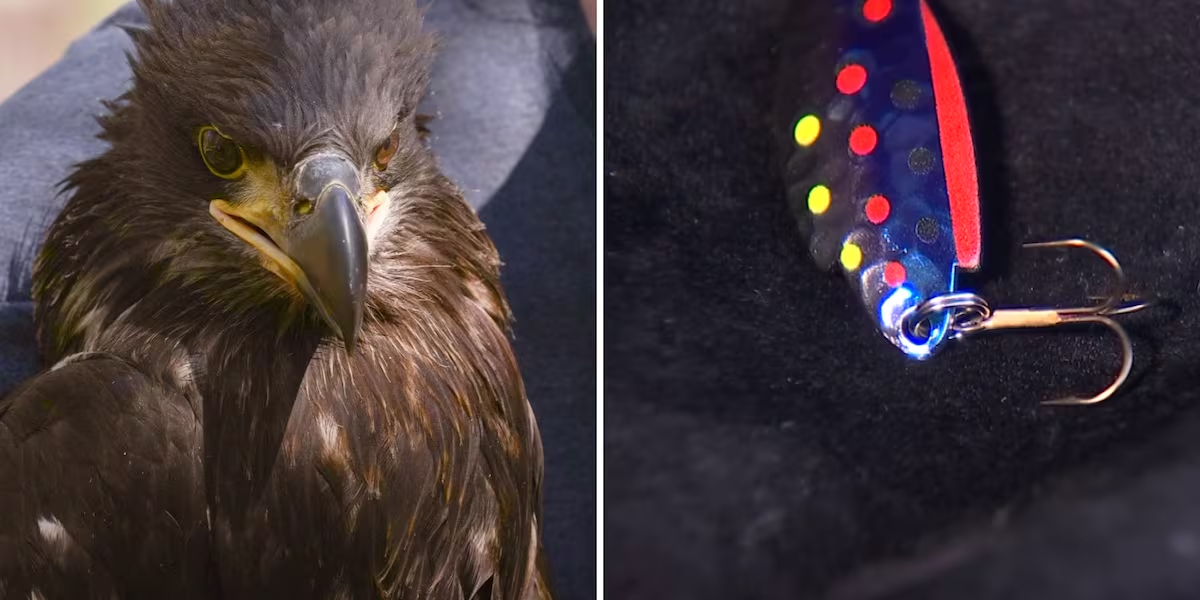
FLAGSTAFF, AZ (AZFamily) — Wildlife biologists rescued a bald eaglet on the Mogollon Rim after the bird swallowed a fishing hook, requiring emergency surgery and ultimately placement with a foster family near Flagstaff.
Read more Phoenix-area murder-suicides: What may be fueling the violence
Discovery at Willow Springs Lake
On May 21, a team from the Arizona Game and Fish Department discovered the eaglet during routine field work at Willow Springs Lake after finding a piece of monofilament fishing line hanging from its mouth. Biologists suspected the bird had swallowed a fishhook lodged in its throat.
“We were able to detangle it from the nest and bring it down to the ground,” said Jennifer Presler, an AZGFD birds and mammals biologist.
The eaglet was transported to Liberty Wildlife, a wildlife rehabilitation facility and AZGFD partner organization in Phoenix, where staff X-rayed the bird and found the hook lodged in its esophagus.
Surgery was performed to remove the hook, though biologists said a small piece could not be safely removed during the procedure. They said they were confident the bird would be able to thrive in the wild.
Foster placement near Flagstaff
By the time the eaglet recovered, its original nest at Willow Springs Lake was no longer occupied, and the parent eagles had already left the area.
On June 19, a team from AZGFD, the U.S. Forest Service’s Coconino National Forest, and volunteers gathered outside Flagstaff to place the nine-week-old eaglet into an active nest containing another eaglet of approximately the same age.
AZGFD eagle field projects coordinator Kyle McCarty climbed roughly 100 feet into a ponderosa pine to place the bird in the foster nest.
“Fostering a nestling from a different nest works because the adult eagles are in parental care mode right now,” McCarty said. “As long as the foster nestling is approximately the same age as their resident nestling, the adults will feed, care for and protect that new one as their own.”
“It has a new sibling in a new nest, and it was looking really healthy and ready to go,” said Presler. “It’s about 11 weeks old now, I believe, and should be ready to hit the skies anytime now.”
Message for anglers
AZGFD said the rescue highlights the importance of properly disposing of monofilament fishing line, which can become tangled around eaglet bodies, wrap around their necks, or accumulate in their stomachs.
Biologists said the hook in this case may have been attached to a fish brought back to the nest by one of the eaglet’s parents.
Read more Tucson ditching fireworks in favor of drones for future Fourth of July celebrations
“Anglers and recreators can help Arizona’s bald eagles and other wildlife by picking up improperly discarded fishing line along waterways, volunteering at clean-up events, and ensuring fresh line of the proper weight are being utilized when fishing,” said Kenneth Jacobson, AZGFD raptor management coordinator.
AZGFD’s Monofilament Recovery Program encourages anglers to dispose of used fishing line in trash containers or recycling bins.
The department also asked anglers not to cut fishing line or return fish with hooks still attached to the water.
Arizona’s bald eagle population
AZGFD tracks dozens of bald eagle nests and more than 100 breeding areas throughout Arizona each year.
The department said Arizona’s nesting bald eagle population is small and relatively isolated compared to other parts of the country.
“Despite some challenges, the nesting population in Arizona has been steadily growing, including several new breeding areas that were found this year,” McCarty said. “The Department is committed to doing what we can to maintain that success.”
“Overall, Arizona’s bald eagle population is doing great and becoming ever more resilient as the breeding population grows annually,” Jacobson said. “Recreators can help by enjoying the eagles from a distance and giving breeding pairs the space needed for successful nesting.”
Bald eagles are federally protected under the Bald and Golden Eagle Protection Act. The species became the official national bird of the United States in 2024.
AZGFD said it will continue to monitor the fostered eaglet and its adoptive family in the coming weeks as it prepares to take its first flight.
See a spelling or grammatical error in our story? Please click here to report it.
Do you have a photo or video of a breaking news story? Send it to us here with a brief description.
Read more Democratic Socialists are winning elections nationwide. Is Arizona Next?