 By admin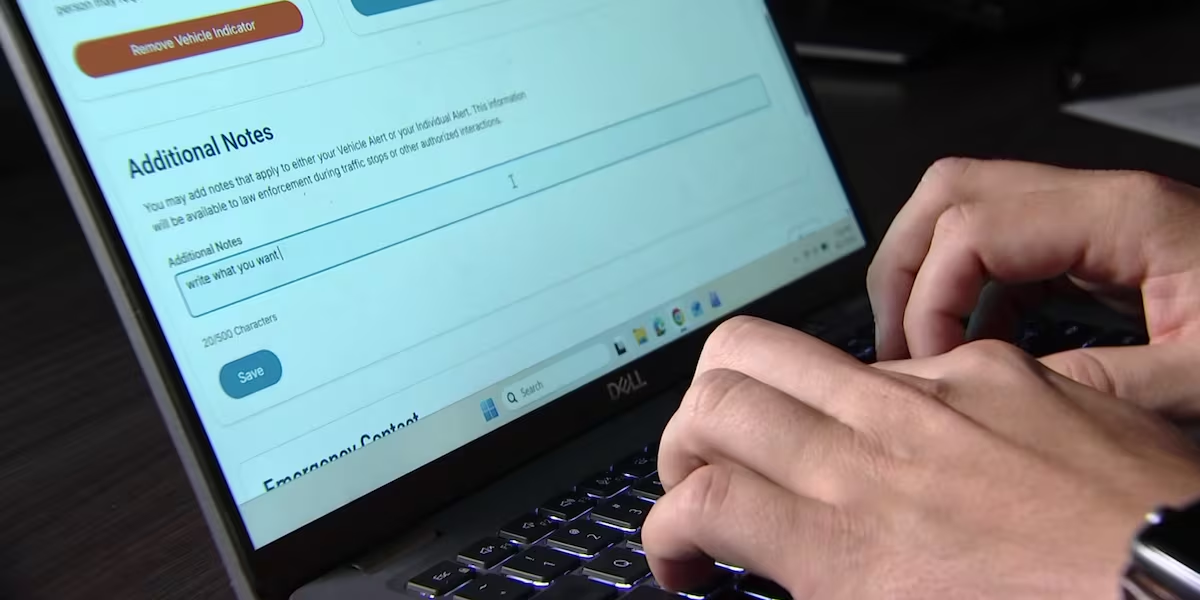
PHOENIX (AZFamily) — A new state feature allows drivers to add information about disabilities or communication needs to their driver’s license, license plate, or VIN, so law enforcement officers can see it before approaching a vehicle during a traffic stop.
Read more One fighting for life following crash near Grant, Rosemont
The feature is part of House Bill 2330, which became law last September.
Chris Timmins and Autumn Timmins came up with the idea for the law after adopting their son, Preston, who is on the autism spectrum.
“If he were to get pulled over, his anxiety is going to go through the roof. He will shut down. He won’t even be able to communicate his name, his date of birth, some of the basic information that they may be asking of him,” Autumn Timmins said.
Chris Timmins, who served in law enforcement for more than two decades, knew how those interactions could go from a police perspective too.
“How can we impact society and make it safer for everybody, not just the first responders, but also for those with disabilities? And we just kind of sat down and said, you know, we need to do something different,” Chris Timmins said.
The couple started the nonprofit Preston’s Pursuit for Acceptance and worked with lawmakers from both parties to write the law.
How the accommodation works
Either on the MVD Now portal or in person at an MVD office, a person can choose to include a communication accommodation and have up to 500 characters to describe their situation. Online, that can be found under the “Other Services” tab at the top of the MVD Now homepage.
Bill Lamoreaux, a spokesperson for the Arizona Department of Transportation, said the accommodations help during traffic stops.
“That really helps the officer and the driver calm things down and actually conduct the actual business at hand and not escalate any stress,” Lamoreaux said.
When an officer runs a license or plate of someone who opts into the service, the custom message they choose appears on the officer’s computer screen.
“It’s all voluntary and it’s only seen by the law enforcement if and when you’re involved in a situation of some kind of pullover or an accident or something like that,” Lamoreaux said.
Read more Phoenix firefighters use rapid ‘ice bag’ therapy to cool hiker rescued from mountain
Before the 500-character option, officers would only see “Communication Accommodation” pop up, which would let them know the interaction might be different, but wouldn’t specify why that is.
“You don’t need a whole dissertation, but you don’t want two words to explain it,” Chris said.
The text box isn’t just for people with developmental disabilities. It can be used to share details of a disease or another condition a person would want law enforcement to know about.
“I think the biggest hope is that they know, like, they’re not going to be judged right away. And that it’s not going to be a question of, you know, is there something else going on with this individual that’s criminal?” Chris Timmins said.
Autumn Timmins hopes that this simple idea can be helpful not only to families and first responders across Arizona, but across the entire country.
“Our big audacious goal is to have this be nationally. Every state to have something like this because, again, we feel like it’s so important. So, yes, it’s here, but we want it everywhere,” she said.
Another feature allows anyone to add an emergency contact that only first responders can see during an incident. Both features are voluntary and can be turned on or off at any time.
See a spelling or grammatical error in our story? Please click here to report it.
Do you have a photo or video of a breaking news story? Send it to us here with a brief description.
Read more How local police who work with ICE could be protected