 By admin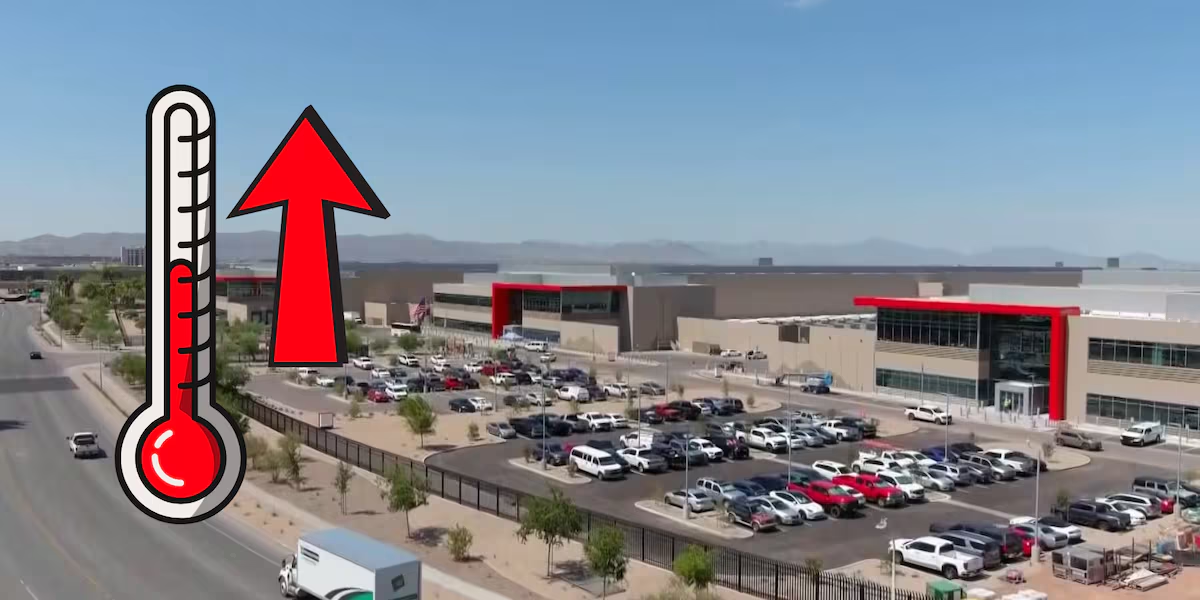
PHOENIX (AZFamily) — A new study from an ASU professor finds data centers aren’t just powering the internet; they may be turning up the heat in nearby neighborhoods.
Read more Medical Examiner report traces timeline of ICE detainee’s care in Arizona before death
Researchers tracked temperatures around four large data centers in the East Valley and found communities downwind are a couple of degrees warmer than other neighbors.
David Sailor, the lead researcher and director of ASU’s School of Geographical Sciences and Urban Planning, said in some neighborhoods downwind of these facilities, temperatures ran about one to two degrees Fahrenheit hotter than areas upwind. In the most extreme cases, temperatures were as much as four degrees hotter.
“There are many other challenges that we need to keep in mind as we design data centers,” Sailor said.
The added heat impacted homes about 500 yards away from the centers.
GENERATION AI: Arizona data centers warming neighboring communities by ‘several degrees’
“Our research is not focused on like halting the expansion of the data centers. Data centers are such an integral and vital sort of part of our economic engine,” Sailor said.
Neighbors living near the facilities said they haven’t noticed extra heat, though they weren’t surprised by the research findings.
Read more 13 CRIME FILES: The murder of Dianne Abbuhl
“I haven’t noticed that to be honest with you,” one neighbor said, “It probably does get hot you know what I mean I don’t notice it.”
Sailor said the temperature increase matters more than it might seem.
“It’s important to recognize that, even one or two degrees of air temperature elevation, it doesn’t sound like a lot, but it can contribute to all sorts of things from basic thermal comfort to water use to air conditioning energies in the homes that are affected by that downwind warming,” he said.
Sailor said the study should help cities explore strategies to counter the heat increase effect or plan where exactly they want these centers.
Earlier this year, a study highlighted by “Generation AI” found that for each one-degree increase during a heat wave, the risk of death rose by 2.5%.
See a spelling or grammatical error in our story? Please click here to report it.
Do you have a photo or video of a breaking news story? Send it to us here with a brief description.