 By admin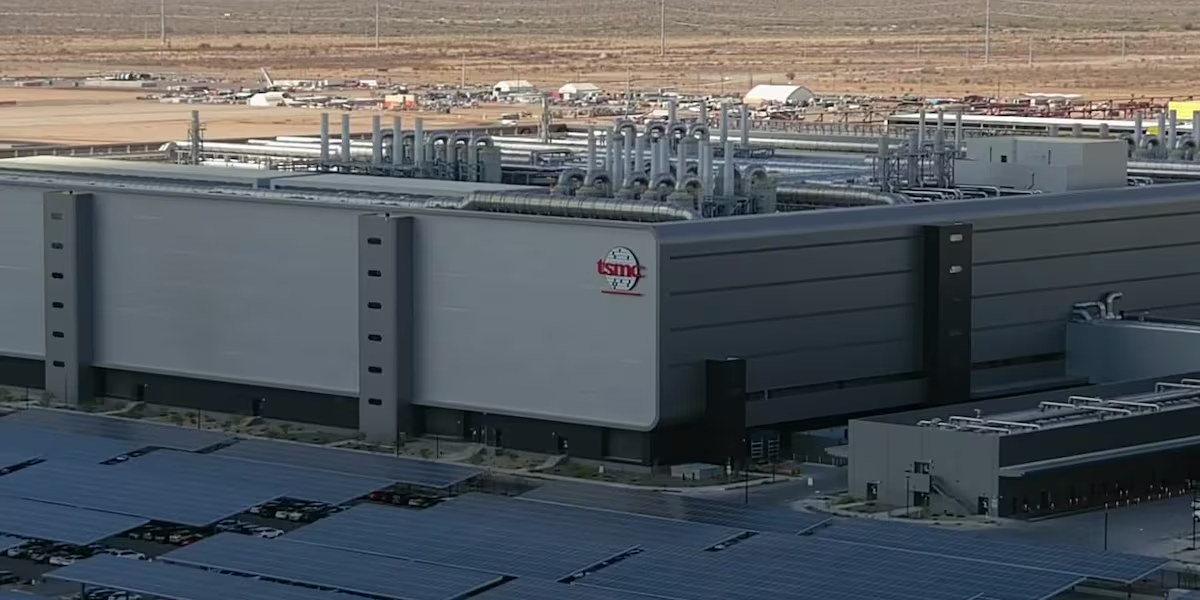
PHOENIX (AZFamily) — Taiwan Semiconductor Manufacturing Co. (TSMC) is pouring another $100 billion into its massive north Phoenix expansion, solidifying Arizona’s position as a global semiconductor hub.
Read more 2 women suffer serious burns after boat explosion on Lake Havasu
But as the chipmaker grows, so do concerns over how much of the desert’s strained water supply the plant will consume—and whether it will affect local residents’ taps.
With Colorado River cuts, many question if it’s a good idea to bring water-intensive industries to the desert right now.
The daily pull: 4.75M gallons
Inside TSMC’s Water Resource Center, engineers confirm the facility uses 4.75 million gallons of water per day. The water is sourced through the City of Phoenix’s water portfolio, utilizing a little bit of groundwater, but the bulk of it is reclaimed wastewater.
RELATED: TSMC Arizona expansion could make it Phoenix’s largest water customer
Water is the lifeblood of chipmaking. Water Department Manager Robert Serrano said manufacturing semiconductor wafers requires ultra-pure water to strip away microscopic particles and contaminants.
“It is critical for our process because it’s how we remove particles, contaminants from our wafers,” Serrano said. “We also have cooling towers, chillers, and abatement units to help us ensure that any sort of fumes and exhausts are properly exhausted before we release them to the atmosphere,” Serrano added.
Cutting the tap: 65% on-site recycling
While the daily intake is substantial, TSMC engineers say they do not draw that entire volume from local reserves every day. Instead, the facility relies on a complex, on-site filtration and recycling system through its water resource center.
“We take factory waste, treat it here in-house, be able to remove some of the contaminants, and then from there, feed it back into our chillers,” said Paige Bensen, a process water engineer.
Currently, this system allows TSMC to recycle 65% of its water intake—about 3.5 million gallons a day. According to Benson, that recycled volume is equivalent to the daily water usage of roughly 12,000 residential homes.
But what happens to the remaining 35%? Experts say a significant portion simply evaporates.
“That’s something like 15%, maybe a little bit more than that,” said Sarah Porter, director of the Kyl Center for Water Policy at Arizona State University. “And that is likely because they’re probably using some form of evaporative cooling. Even your Costco, your Walmart will have evaporative cooling.”
TSMC operates under a strict City of Phoenix industrial pretreatment discharge permit. Because chipmaking involves heavy chemicals, the city requires the company to treat and clean its wastewater on-site to rigorous safety standards before any of it is discharged into the public sewer system.
The push for 90% reuse by 2028
To further reduce its reliance on city water, TSMC has broke ground on an advanced industrial reclamation water plant. Once operational, the new facility will treat the water that cannot currently be recycled, using specialized biological, physical, and chemical processes.
Read more Rare heat injury in dogs prompts warning from Arizona veterinarian
“With this reclamation plant, we’ll be able to go from 65% reuse all the way to 90% reuse or better within TSMC,” Benson said.
However, that reclamation plant is not slated to be fully operational until 2028.
A calculated risk for the Valley’s economy
The debate over TSMC’s water footprint highlights a broader tension between economic growth and environmental sustainability in Arizona.
“It’s very hard to think of economic activities that don’t use water,” Porter said. “So much now depends on the cloud—like data center services—and whether it’s through electricity or water-based cooling, there’s water use. It just takes water to have an economy, to have a city.”
According to Porter, the City of Phoenix made a deliberate calculation when permitting and accommodating TSMC’s massive campus.
“The city determined, it’s a big employer. It’s going to lead to development in a part of Phoenix which will generate all kinds of revenues,” Porter said. “So the city looked at that water use and said, ‘We have enough water to do that.’”
TSMC representatives insist they are committed to minimizing their impact on the surrounding community.
“At TSMC, we want to be a good neighbor, which means that we want to reuse as much water as possible,” Benson said. “So that way we’re relying less on city water usage and maintaining a closed loop within our campus.”
“We know that we are a big water user,” Serrano added. “I want residents to know that semiconductors are big users of water—we know that—but we also reuse a lot of our water.”
See a spelling or grammatical error in our story? Please click here to report it.
Do you have a photo or video of a breaking news story? Send it to us here with a brief description.
Read more Search for suspect after man killed in Tucson shooting