 By admin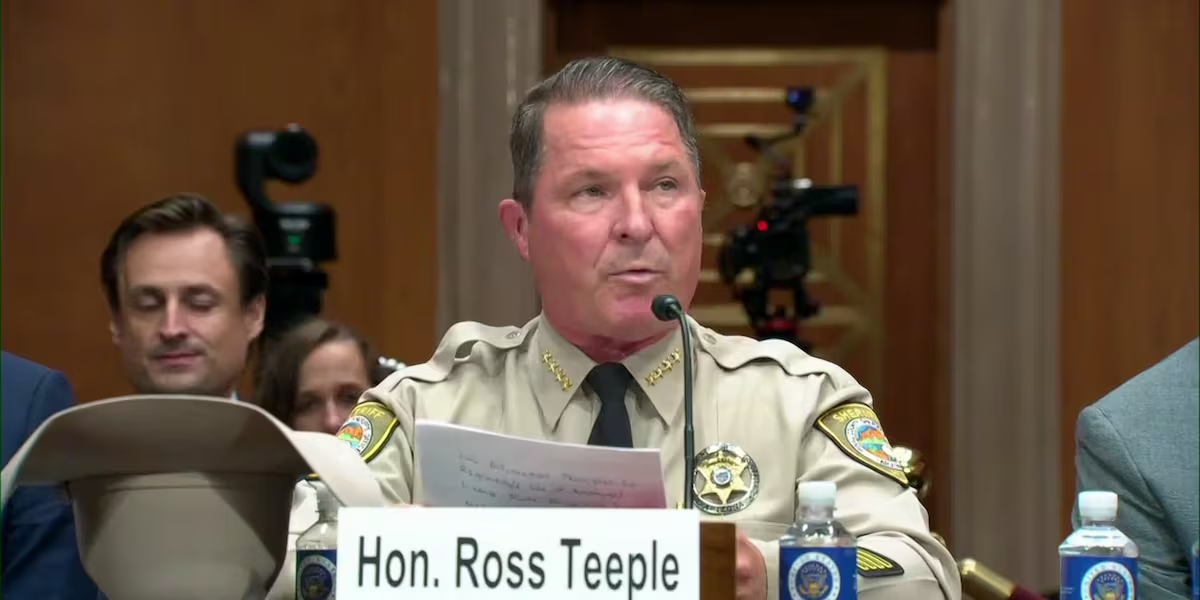
WASHINGTON, DC (AZFamily/InvestigateTV) — Pinal County Sheriff Ross Teeple called for more oversight of automated license plate reader cameras during testimony before a U.S. Senate subcommittee Wednesday.
Read more Task force tackles decades of unidentified remains in Coconino County
Teeple testified about Flock technology after Pinal County announced it was ending its contract with the company in early August.
He warned the cameras could eventually be used for more than reading license plates. Teeple said law enforcement agencies should not wait for broader oversight to get rid of the technology.
Teeple testified that the latest AI-powered cameras pose a threat to constitutional rights.
“Let’s not allow a private company that is way overreaching in their artificial intelligence technology to strip us of a valuable law enforcement tool,” Teeple said to Arizona’s Family in an interview after the hearing.
Case highlights use, raises transparency concerns
Teeple noted the technology’s utility in criminal investigations, citing a local case where automated license plate readers tracked an aggressive driver who pushed a woman’s car into oncoming traffic. He voiced alarm over transparency.
Teeple said he grew concerned after asking Flock Safety about the use of AI in its equipment. He said he was initially told no AI was used, but later found company statements contradicting that claim.
“The response I received was chilling,” Teeple testified. “I was told, ‘That wasn’t the AI you were asking about.’”
Researcher flags security vulnerabilities
Benn Jordan, an independent security researcher who discovered dozens of Flock cameras streaming openly online, warned lawmakers about systemic digital vulnerabilities.
“Why create this much data when we can’t secure it?” Jordan asked. He urged Congress to ensure any regulations placed on Flock apply universally across the surveillance industry, including competitors like Axon.
Wednesday’s Senate hearing was looking into how police officers have abused automated license plate readers to stalk civilians and fellow officers.
The hearing before the Senate Judiciary Subcommittee on Crime and Counterterrorism, titled “Always Watching: Flock’s Nationwide AI Surveillance Network,” came directly in the wake of an extensive series by InvestigateTV.
“The reporting on what these cameras can do is really pretty wild,” said U.S. Sen. Josh Hawley, R-Missouri, who chairs the subcommittee. “The Constitution of the United States is still just as valid and applicable today as it was almost 250 years ago. We have to find a way to protect and enforce the Bill of Rights for every law-abiding citizen of the United States.”
Hawley noted the hearing’s purpose was to “figure out what is going on” with automated surveillance cameras, adding, “If you haven’t heard of Flock, Flock has probably heard of you.”
Hawley pointed out that none of the chief executives invited to testify appeared at the hearing: Garrett Langley, CEO of Flock Safety; Rick Smith, CEO of Axon Enterprise; Greg Brown, CEO of Motorola Solutions; and Filip Kaliszan, CEO of Verkada.
Flock Safety operates more than 120,000 automated license plate reader (ALPR) cameras across the country, capturing millions of vehicle movements daily.
The data is retained and searchable by law enforcement agencies across jurisdictions for 30 days.
While Flock launched an AI-powered “audit assistance” tool earlier this year to flag suspicious activity for municipal supervisors, reporting showed that victims often only discovered improper searches through independent public records requests and third-party tools like haveibeenflocked.com.
Privacy advocates and public records watchdogs also raised alarms after Flock removed officer names from external network searches and stripped license plate numbers entirely from system audit logs, severely limiting the public’s ability to verify whether their vehicles had been searched.
“This is still the United States of America, and it shouldn’t be that when you walk out your door in the morning, you just have to agree, in a sense, to accept the fact that you’re gonna be on camera, morning, noon, and night,” Hawley added. “You’ll be tracked by anybody and everybody in the world. You’ll have no privacy whatsoever.”
U.S. Sen. Dick Durbin, D-Illinois, echoed calls for federal intervention, emphasizing the urgent need to address constitutional boundaries.
Read more All 4 suspects arrested in deadly Casa Grande house party shooting
“We have got to find a way to balance in America privacy and security,” Durbin said. “There is a balance. Congress needs to lead the way.”
Bipartisan concern was further highlighted when U.S. Sen. Katie Britt, R-Alabama, entered into the official record a joint letter with Sen. Raphael Warnock, D-Georgia, expressing serious concerns over potential civil liberties violations stemming from the widespread deployment of license plate readers.
Supporters and privacy advocates split
Supporters say license plate readers can help investigators solve serious crimes and find dangerous drivers. Privacy advocates raised concerns about hacking, data access and the possibility of searches without a warrant.
Arizona cities and towns continue to cancel contracts
Cottonwood became the latest city in Arizona to announce it is canceling its Flock contract on Tuesday, weeks after the city suspended its use after concerns from people in the community.
In total, around a dozen cities across the state have announced changes to their use of ALPR systems in recent weeks. More, including Scottsdale, are set to take up this issue in the coming weeks.
Sheriff Teeple told Arizona’s Family that he feels there needs to be a statewide approach to this issue. Earlier this year, a bill that would have put in place statewide guardrails for ALPR systems failed to make it out of the state senate.
“I think we should all get on the same page,” said Teeple.
In August, Arizona Attorney General Kris Mayes announced a review of how law enforcement agencies across the state have been using the systems. Gov. Katie Hobbs says she supports common-sense guardrails and local control for these systems.
There needs to be very strict laws about how this surveillance technology is deployed. Flock needs to be held accountable for how its technology is being used. Full stop. Americans deserve to know who has access to the information these cameras collect, how that data is being shared, and what safeguards, if any, are in place to prevent abuse. Today’s Senate Judiciary Committee hearing would have been an opportunity to get answers directly from the people leading on this tech, but some failed to show up. I think it’s very important that the companies developing technology with such serious implications for Americans’ privacy and civil liberties have a responsibility to answer these questions, not avoid them.
Innocent woman jailed for 13 days after errant camera match
Among the witnesses who testified was Lindsay Issacs, a Florida woman who recounted how an automated camera match upended her life.
Issacs was arrested in Florida on charges of causing a fatal vehicle accident that killed three people after Florida troopers built their case around an ALPR hit. She spent nearly two weeks behind bars before a subsequent investigation proved law enforcement had identified the wrong vehicle.
“A Flock camera captured my vehicle a few miles from a terrible crash I had nothing to do with that led to 13 days in jail,” Issacs testified.
Other witnesses testified that modern, interconnected cloud networks and artificial intelligence make today’s camera systems fundamentally different from traditional license plate readers.
“We are a long way from a simple automated license plate reader,” Hawley noted, following testimony from Alasdair Whitney, legislative counsel for the Institute for Justice, who pointed out that cameras linked to cloud networks represent a drastic shift.
Whitney urged Congress to establish firm federal guardrails, including requiring law enforcement to obtain search warrants prior to scouring historical license plate databases.
“The Fourth Amendment is a floor, not a ceiling,” Whitney said.
Civil liberties advocates call for federal guidelines
Chad Marlow, senior policy counsel for the American Civil Liberties Union, told the committee venture capital investment has transformed public-safety tools into an unchecked surveillance industry.
“The explosion of ALPR use and its tracking of innocent people reflects a view that if ALPR use is scaled up, it could produce the massive profits venture capitalists seek,” Marlow said. “Welcome to the surveillance-industrial complex, America.”
Marlow testified that Flock’s existing safeguards fail to address the core problem of systemic misuse and urged Congress to use its spending powers to halt the technology entirely.
“The time has come for Congress to ban any law enforcement entity who receives federal funding from using ALPRs,” Marlow said. “This prohibition should be without exceptions… when it comes to protecting core American civil rights and civil liberties, if you make one exception, you invite others, and that is a slippery slope we must avoid at all costs.”
See a spelling or grammatical error in our story? Please click here to report it.
Do you have a photo or video of a breaking news story? Send it to us here with a brief description.
Read more Tucson’s first St. Jude Dream Home unveiled in Catalina