 By admin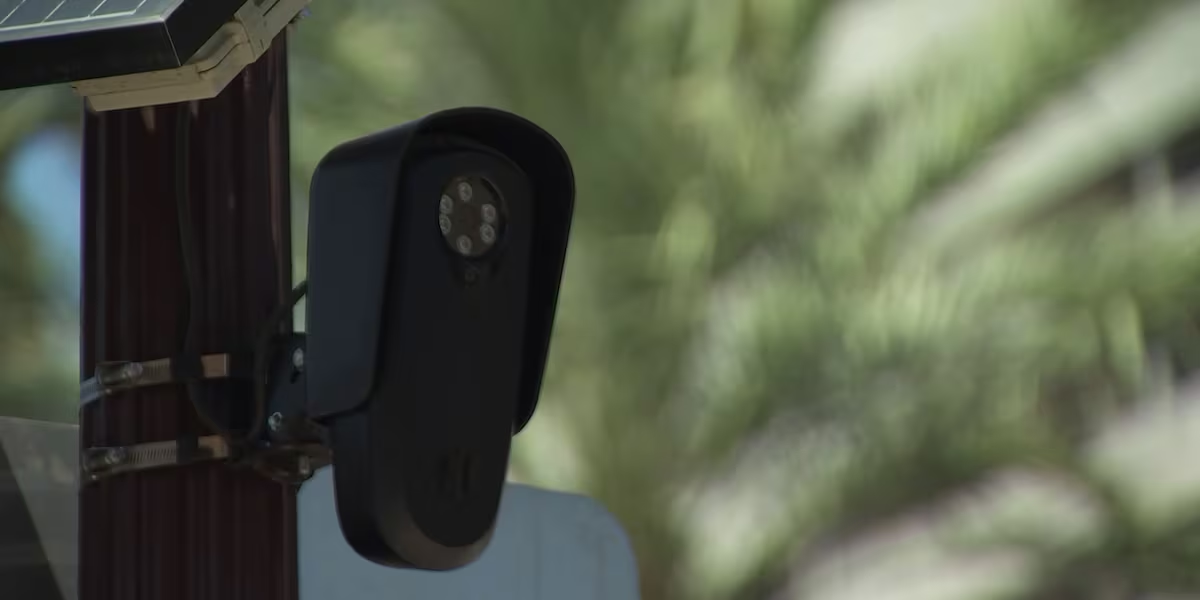
TUCSON, Ariz. (13 News) – Faculty Senate President Dr. Leila Hudson has spent months trying to answer questions about the University of Arizona’s license plate reader system.
Read more Arizona’s chip footprint grows, but TSMC’s water demand sparks questions
“Frankly, we have more questions than answers at this point,” Hudson said.
In February 2025, the University of Arizona approved an $870,000 contract (over five years) with Flock Safety to install 62 automated license plate reader cameras across campus. For perspective, the town of Oro Valley and Arizona State University each have about 20 cameras.
Committee reviewing camera system
Hudson said a committee of students, staff and community members is making progress on reviewing the system.
“How much do we pay for these systems, who controls the data, who has access to the data, what guidelines are you putting in place to make sure the data collected is primarily for public safety?” Hudson said.
Hudson said her ad-hoc committee will release an interim report within days with recommendations for the university’s ALPR system. She said she will share the report with the office of public safety for feedback before it is made public.
“We’re all on the same team here. Everybody cares about public safety. But everyone also cares about our constitutional rights and freedoms,” Hudson said.
Hudson said she believes it is every citizen’s duty to ask questions.
“If you don’t ask, you don’t find out,” Hudson said.
Student raises privacy concerns
Student Arian Chavez said he does not think ALPRs as crime-fighting tools outweigh their potential for profiling and reducing privacy, not just at the University of Arizona, but in the broader community. Chavez said he also worries third parties could acquire and misuse data.
“We are the people and we should have a say and we need to have our voices heard immediately,” Chavez said.
“The students’, teachers’, professors’ inputs were not considered at all when deciding to put up these cameras or starting this contract with Flock Safety. And also, it’s invasive,” Chavez said.
Fact Finders obtained a copy of the which shows annual subscription costs of about $160,000 a year, paid through public university funds. Chavez said he would rather see that money go to programs to help students.
University policy prohibits certain uses
Under effective December 2025, personal or unofficial investigations, general surveillance unrelated to a public safety mission, and targeting individuals based on protected characteristics are listed as prohibited, fireable offenses.
Read more 2 women suffer serious burns after boat explosion on Lake Havasu
Flock use is also subject to regular audit and must comply with the Fourth Amendment, according to the policy. Data is deleted after 30 days and may be shared only with law enforcement agencies for approved purposes.
“The university does share information with other local police agencies, that does not mean those agencies don’t share that information with the federal government,” Chavez said.
U of A’s chief safety officer said last fall the university was not sharing data with the U.S. government. Records from the Electronic Frontier Foundation showed UAPD conducted searches for the U.S. Marshals last year. That helped prompt the new policy.
The department is sharing with more than 64 law enforcement agencies across Arizona and receiving data from about as many, contracted for 59 cameras.
Transparency portal shows camera activity
The U of A Flock Transparency Portal showed 58 active cameras detected more than 156,000 unique plates in 30 days, with the top offenses used for searches being property destruction.
Flock Safety says its cameras help solve about one in five crimes nationally. A company-backed study found agencies with more Flock cameras see about a 9% bump in crime-clearance rates per camera per officer. There is no independent evidence that Flock cameras by themselves reduce total crime.
Hudson said transparency and allowing all points of view remain necessary.
“Because we are not privy to the fine print in those contracts, the add-ons that might or might not be paid for, every area needs to do its own diligence. Every university, every municipality needs to figure out what is going into these contracts and what they empower, and make sure that we as a community are not caught by surprise again,” Hudson said.
University public safety was contacted for comment. A spokesperson said they have nothing to add at this time and referred to the U of A’s dedicated website for information on automated license plate readers. The website shows no sharing with federal agencies at this time.
====================================================
Are you streaming 13 News?
Watch a free live stream of Tucson Now and 13 News at TucsonNow.Live.
Be sure to download the free Tucson Now app which you can find on Apple and Google.
If you are using a desktop computer, you can use your mobile device to scan the QR code below.
Read more Rare heat injury in dogs prompts warning from Arizona veterinarian
You can submit your breaking news or weather images here.