 By admin
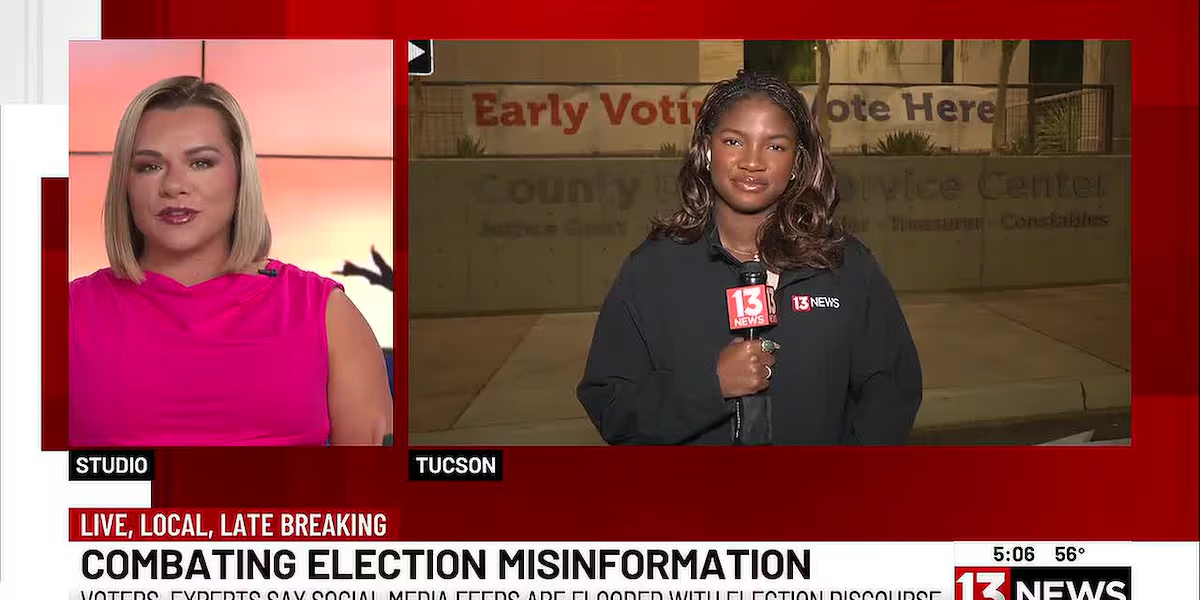
TUCSON, Ariz. (13 News) – One week before the midterm election, Arizona voters say their morning scroll is loud, mean and hard to learn from.
Read more Tucson Now: Esteban Flores’ plan for AZ Senate D-21
“There’s not a lot of what I’m going to do for you, it’s a lot of you are evil, this other guy is evil,” said William Laney, a 61-year-old Arizona voter.
Christina Smith, a 30-year-old voter, said she’s trying not to add to it.
“I think it’s really important that we don’t feed into the polarizing, combative energy,” Smith said.
It’s not fakes everywhere — it’s half-truths in clusters
Yotam Shmargad, an associate professor in the University of Arizona School of Government and Public Policy who studies social media and campaigns, said election misinformation right now is not really widespread. It typically lives in specific clusters targeting hyper-partisan people.
“What you’re consuming is not necessarily untrue, but it’s an incomplete picture,” Shmargad said.
That selective, partial information is powerful because voters don’t scrutinize what they agree with. Shmargad said people are hypercritical of what they don’t agree with even when it’s reliable, but let posts that fit their worldview slide by.
“You’re much more likely to receive misinformation if you’re a sort of hyper-partisan in environments where alternative media sources are being used,” he said.
He distinguishes misinformation, disinformation, and malinformation – saying it’s about intent, not just the information.
The upside of social media during an election cycle, he said, is moving away from a small, uniform set of gatekeepers to more representative voices. He said the downside is echo chambers keep you in your bubble and the system rewards clickbait and sensational posts because they spread faster.
His pre-election advice is to try “prebunking.” Look at the source first, ask if it follows ethical practices, and add various traditional news outlets into your news diet.
“Spend a lot of time around people that are different from you, that might be coming from different backgrounds, that see the world a little bit differently,” Shmargad said.
Read more Police, FBI respond to shooting on Pascua Yaqui reservation
AI cuts both ways
Rita Tang, an assistant professor of communication who studies contested information and AI literacy at the University of Arizona, called AI a double-edged sword. On the helpful side: some social media platforms use Community Notes and AI tools to respond to inaccurate information, and voters themselves use AI to cope with information overload.
“I’ve seen people try to use artificial intelligence to summarize policies, because let’s be real here, those voter education guides they give us are really long,” Smith said.
On the harmful side: Tang said campaigns may use AI in political ads with an intention to paint opponents in a bad light, and malicious actors often use bots to troll and interrupt genuine conversation.
“That may really interrupt the genuine conversation or interaction between humans,” Tang said.
Tang said her own research has shown that people are aware of AI, but as the technology advances, it gets harder to detect. She said it’s not about age or tech skills – it’s worldviews that make people susceptible.
“Skepticism can potentially become cynicism,” Tang said. “We may need to build this healthy skepticism, so when people encounter information that’s misleading they’re able to tell what is accurate information and what is misinformation.”
As the technology advances, Tang said spotting AI can also become more difficult. She recommends looking at the source, watching for grammatical errors and other cues, being cautious, and using fact-checkers.
What voters can do now
Shmargad and Tang agree that navigating an election cycle online can be particularly difficult when family and friends share posts that may be hostile or inaccurate. They recommend leading dialogue with empathy, presenting counter arguments with evidence, and expanding worldviews.
Verified information about this year’s election is available on the Arizona Secretary of State website. Candidate and proposition guides are available on our Arizona Decides.
Read more ‘Star Trek’ actor Walter Koenig dies at 90, reports say
Did you know 13 News has podcasts? Here’s the link to see the lineup.